
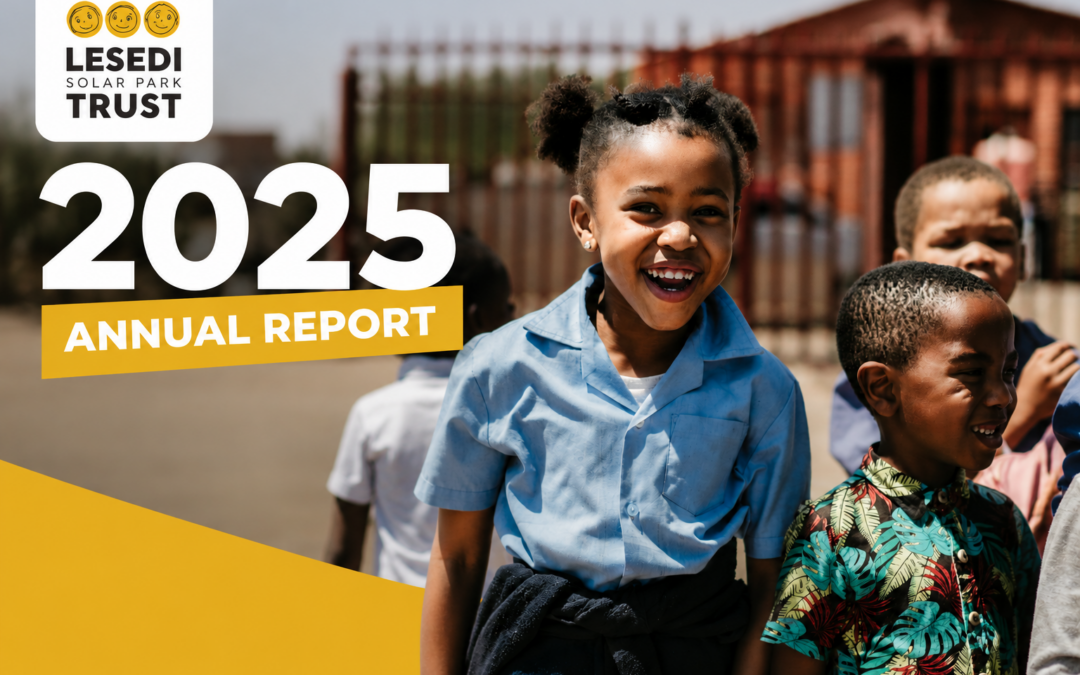
The year 2025 marked our midterm, the halfway mark to the Lesedi Solar Park Trust’s strategy, and our newly released annual report reflects what that milestone taught us. It was a year of real delivery, and it was also a year in which reaching this halfway point pushed us to ask a harder question than usual: what does it actually take to deliver programmes that work, not just for communities, but with them?
That question led us into a deeper kind of listening than we had practised before. It asked us to be curious not only about what programmes were achieving, but about the conditions of the people we were delivering them for and alongside. Through a trauma-informed leadership and governance process undertaken this year, we began to understand something that reframed much of how we think about our work. Personal, family, and collective trauma runs through these communities, shaping how people engage with services, with organisations, and with one another. That trauma does not stop at the community’s edge. It lives too in the people who deliver our programmes, many of whom come from these same communities, carrying their own histories alongside the work they do on our behalf. Left unacknowledged, that trauma can quietly undermine leadership, governance, and collaboration, even where resources and good intentions are already in place.
This is why we extended trauma-informed training beyond our own board to our implementing partners as well. The aim was not simply to build awareness, but to guard against the very real risk of causing further harm through the way we deliver, even with the best of intentions. It became clear that healing and governance cannot be treated as separate concerns if our development efforts are to be effective and sustainable.
That same learning pushed us to be curious about something else: the capacity, knowledge, and resources that already exist within the communities we serve, often overlooked simply because they sit outside formal structures. We came to understand more fully that the Trust cannot, and should not, be the sole driver of change. The intelligence, history, and lived experience held by communities themselves are assets in their own right, and sustainable change depends on our ability to work alongside them rather than ahead of them.
None of this came at the expense of delivery. This year, more than 700 young children accessed early learning through our community-based programmes, and over 3,700 children developed early literacy skills. Fourteen learners were placed in TVET college or university pathways, two of them graduating with distinction, and the 2024 Grade 12 cohort supported through REAP achieved a 90 percent matric pass rate. Eighteen young people from within the Lesedi community were trained and employed as facilitators through our Accelerated Learning Project, delivering literacy and numeracy support directly to their peers. These outcomes sit at the centre of what this year meant, not as a separate story from the reflection above, but as evidence of what happens when delivery and deep listening are allowed to shape each other.
As we move into the second half of this strategy, that learning is what we are beginning to carry forward. We are socializing a way of working that recognizes it takes multiple actors, community members, local organisations, government, and other stakeholders, to build lasting change and to sustain it over time. This is the shift our midterm reflection is pointing us toward, moving beyond the delivery of programmes on their own, toward a more connected, collaborative way of working, one that trusts community as a genuine partner in shaping what comes next.
We invite you to read the full 2025 annual report, available to download on our website and in print at key community points, and to walk this next chapter with us.